01What this AI visibility checker measures
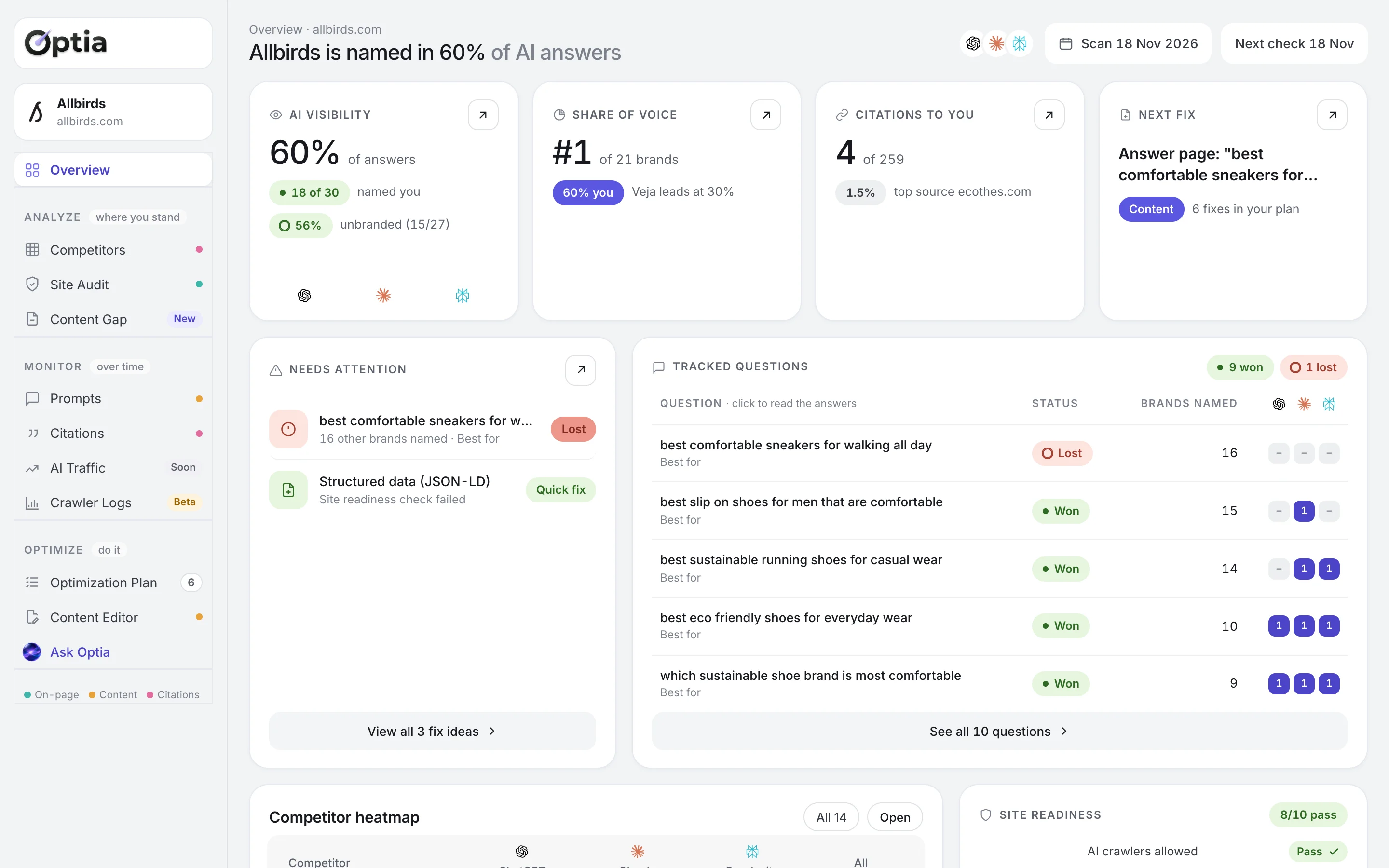
Optia's free AI visibility checker asks AI engines the questions your buyers ask, then reads every answer. It doesn't grade your website and guess. It records what the engines actually said: whether they named your brand, who they named instead, and which pages they cited as sources.
| What you see | What it tells you |
|---|---|
| AI visibility score | The share of answers that name you. 15 answers with 3 mentions is a score of 20%. |
| Share of voice | How often you're named compared with the competitors the engines name for the same questions. |
| Position | Where you appear in the answer: named first, third or not at all. |
| Sentiment | Whether the answers that mention you recommend you, stay neutral or warn against you. |
| Cited sources | The pages the engines trusted for their answers: your site, competitors, review sites, Reddit threads, articles. |
| Site readiness | Up to 19 checks on what AI crawlers and search engines can read on your site, including robots.txt, llms.txt, structured data, prices and whether Bing has indexed you. |
Together these answer the question most businesses are really asking: when a buyer asks ChatGPT-style assistants for a recommendation in my category, am I in the answer, and if not, who is?
02How the free AI visibility check works
- You enter your website. No account and no card. The scan starts right away.
- Optia reads your homepage and works out what you sell, who buys it, where you operate and who you compete with.
- It picks 5 buyer questions: 3 common questions in your category, 1 about your specialty and 1 that names your brand. Each one is checked against Google autocomplete, so the questions match what people actually type.
- It asks Claude, Perplexity and DeepSeek each question with web search switched on, the way a new user with no history would ask. That's 15 real AI answers.
- It reads every answer and records the brands named, their order, the tone and every cited link.
- You get the report with your AI visibility score, share of voice, the answers themselves, the top sources and your site readiness checks. Enter a business email to open it.
A scan usually takes a minute or two. You can watch the answers come in live while it runs. If you'd like to see the format first, open the sample report.
Check your AI visibility now. It's free and takes a minute or two.
Run free scan03What is a good AI visibility score?
There's no universal benchmark yet, and anyone who quotes one is guessing. What a score means depends on your category and on how many brands the engines name for it. A useful way to read your result:
| Score | What it usually means |
|---|---|
| 0% | No engine named you for any of the questions. Common for newer or niche brands, and the clearest sign there's work to do. |
| 1 to 20% | You show up for some questions on some engines. Look at which ones, and which competitors take the rest. |
| 20 to 50% | You're part of the conversation. Share of voice tells you whether you lead it or trail. |
| 50% and above | Engines name you in most answers. Protect it: answers change as engines and sources change. |
Compare yourself with competitors rather than with an absolute number. If AI engines name three rivals in 60% of answers and you in 10%, that gap matters more than the 10% on its own.
Keep the sample size in mind too. The free check gives 15 answers, so each answer moves your score by about 7 points. One check is a snapshot. Answers vary from run to run, which is why paid plans re-ask the same questions and track the trend.
04Why a website score is not an AI visibility check
Many free tools give you an "AI readiness" or GEO score. They read your pages and grade things like headings, schema and how easy the text is to quote. That's useful, but it measures your website, not your visibility. A well-structured site can still be missing from every answer, because engines lean on third-party sources: review sites, directories, articles and forum threads.
An AI visibility check works the other way round. It starts with the answers. Optia does both: the readiness checks tell you what crawlers can read, and the 15 answers tell you whether any of it is working.
05Which AI engines does the checker cover?
The free scan asks Claude, Perplexity and DeepSeek. Paid plans add ChatGPT and ask all four on every check, and can also record whether Google AI Overviews appear for your tracked questions and which sites they cite.
Engines disagree more than you'd expect. It's normal to be named by Perplexity and missed by Claude for the same question, because each one searches and weighs sources differently. That's why a checker that covers a single assistant only shows you one slice of your AI visibility.
06How is this different from the Semrush or Ahrefs AI visibility checkers?
Several SEO platforms now offer a free AI visibility checker, and each is a fair place to start. Here's how the free versions compared when we checked their pages in November 2026:
| Tool | Free limits | Signup | Engines checked |
|---|---|---|---|
| Semrush | Three runs per day | No | Not stated on the page |
| Ahrefs | Results in seconds | No | ChatGPT, Gemini, Perplexity, Copilot, Google AI Overviews |
| Frase | First result free; more engines after an email | Email for more | ChatGPT; Perplexity and Gemini after email |
| Omnibound | Results in under a minute | No | Not stated on the page |
| Search Engine Land | Tests 150 AI queries | Yes | 3 AI platforms |
| Optia | One free scan per visitor, 15 answers | Business email to open the report | Claude, Perplexity, DeepSeek (paid plans add ChatGPT) |
Ahrefs covers the widest set of assistants for free, and Search Engine Land runs the most queries. Where Optia differs is in what the questions are and what you get back. The questions are picked for your business from your own homepage and checked against real searches, rather than a fixed vendor list. And the report shows the full answers, the competitors named instead of you and the sources behind them, so you can see why you were left out, not just that you were.
07Is there a completely free AI visibility checker?
Yes. Optia's checker is free with no card: you get one full scan per visitor. To open the report, enter a business email. That's the only gate.
The free report shows your AI visibility score, the full answers for the first 3 questions, your top competitors in share of voice, the top cited sources and every site readiness check. Paid plans unlock every answer, every competitor and source, and the fixes.
08Can I track my AI visibility over time for free?
You can, by hand. Pick 15 to 20 questions your buyers would ask an AI assistant, ask them in each engine on the same day every week, and log the date, the engine, whether you were named, the cited URLs and the tone in a spreadsheet. After a few weeks you'll have a trend line you can trust.
It works for one brand and a handful of questions. It stops working at five competitors and a hundred questions, which is where tracking tools come in. Optia's Monitor plan is $49/month for 1 brand and 50 tracked questions, and Grow is $99/month for 100 questions plus AI-drafted articles and monthly fixes. See pricing.
09What should an AI visibility report include?
Whichever tool you use, check that its report gives you these before you rely on it:
- More than one engine. A single-assistant result is a partial answer.
- Real buyer questions. Vendor-picked prompts are fine for a demo and misleading as a benchmark.
- The answers themselves. A score without the text behind it can't be checked.
- Competitors by name. Knowing you're absent is less useful than knowing who took the spot.
- Cited sources. These are the pages to fix, earn a mention on or outdo.
- History. Without a baseline you can't tell whether you're gaining or slipping.
- Next steps. A score with no fixes is a curiosity, not a plan.
10Turn your results into a free AI visibility audit
The check tells you where you stand. An audit tells you why, and what to change first. You can run a basic one yourself from the free report in under an hour:
- List the prompts you lost. For each question where a competitor was named and you weren't, note who won and on which engine.
- Read the winning answers. Look at how the engine describes the brands it recommends: the words, the claims, the proof. That's the bar your pages and mentions need to clear.
- Open the cited sources. If the same review site, comparison article or Reddit thread keeps coming up, that page is shaping the answer. Getting listed or mentioned there is often worth more than a new page on your own site.
- Fix the readiness checks that failed. Blocked AI crawlers, a missing llms.txt or a homepage that needs JavaScript to show its text are quick wins.
- Answer the exact question. Write one clear page per lost prompt, with the direct answer in the first two sentences, real prices and specifics, and a short FAQ.
- Re-check the same prompts. Use the same questions on the same engines, so the before and after compare like with like.
Most AI visibility tools stop at the score. The fixes are where mentions are won, and they're what Optia's paid plans work through with you: a ranked fix list, drafts of the pages and the sources worth pursuing.
11How long until fixes show up in AI answers?
It depends on how the engine builds its answer. Engines that search the web while answering, such as Perplexity and the search modes of ChatGPT and Claude, can reflect a new or improved page once it has been crawled and indexed, often within a few weeks. What a model learned during training only changes when it's retrained, which takes months.
So the fastest wins tend to be the sources the engines already cite: a clear page that answers the exact question, a listing on the review sites they trust, and an accurate description of your business across the web. Re-check the same questions after each change, so you know what actually moved your score.
12Frequently asked questions
Is the AI visibility checker really free?
Yes. One full scan per visitor, no card. You enter a business email to open the report.
Which AI engines does the free check use?
Claude, Perplexity and DeepSeek, with web search on. Paid plans add ChatGPT.
How many questions does it ask?
Five buyer questions picked for your business, asked once on each engine: 15 answers in total.
How long does a scan take?
Usually a minute or two. You can watch the answers arrive while it runs.
Does it check Google AI Overviews?
Paid plans can record whether Google AI Overviews appear for your tracked questions and which sites they cite. The free scan covers Claude, Perplexity and DeepSeek.
How is an AI visibility tool different from a rank tracker?
A rank tracker records where your pages sit in Google's list of links. An AI visibility tool records whether AI engines mention your brand inside the answer itself, which competitors they name and which sources they cite. You can rank first on Google and still be missing from the AI answer.
Why do AI engines recommend my competitor and not me?
Usually because the sources they search and trust mention your competitor more clearly: review sites, comparison articles, forum threads and well-structured pages. The report shows those sources, so you know where to start.
See where you stand in AI answers today.
Run your free AI visibility check